

Have you ever worn a color that looked beautiful on someone else, but on you it just felt wrong? Maybe your face looked dull, your skin looked uneven, or your outfit never looked as polished as you hoped. A lot of people think the problem is their makeup, wardrobe, or styling skills, when in reality, the issue is often much simpler: they are wearing colors that do not match their natural coloring. This is one of the most common frustrations behind questions like “What is my color season?” because people often know something looks off, but they do not know why.
From years of seeing how color works on different skin tones, hair colors, and contrast levels, one thing becomes very clear: the right colors can completely change how a person looks. When a flattering shade is placed near the face, skin often looks fresher, eyes appear brighter, and the whole face looks more balanced. The wrong color can do the opposite. That is why seasonal color analysis matters. It gives you a practical way to understand why some colors work so well for you, and why others never seem quite right.
Quick Takeaway
Your color season is based on three main things:
- Undertone (warm or cool)
- Contrast (light or deep)
- Chroma (soft or bright)
Most people fall into Spring, Summer, Autumn, or Winter. The goal is to find colors that make your skin look clearer, your eyes brighter, and your features more balanced.
What Is Seasonal Color Analysis?
Seasonal color analysis is a way to find the colors that suit you best.
Seasonal color analysis is a type of personal color analysis that helps you find your most flattering colors.
It groups people into color seasons based on how they look.
These seasons are:
Each season has a set of colors that match your natural tone.
The goal is simple:
👉 Wear colors that match you, not fight against you.
The goal is to create color harmony between your natural features and the colors you wear.
The 3 Dimensions of Color That Determine Your Season
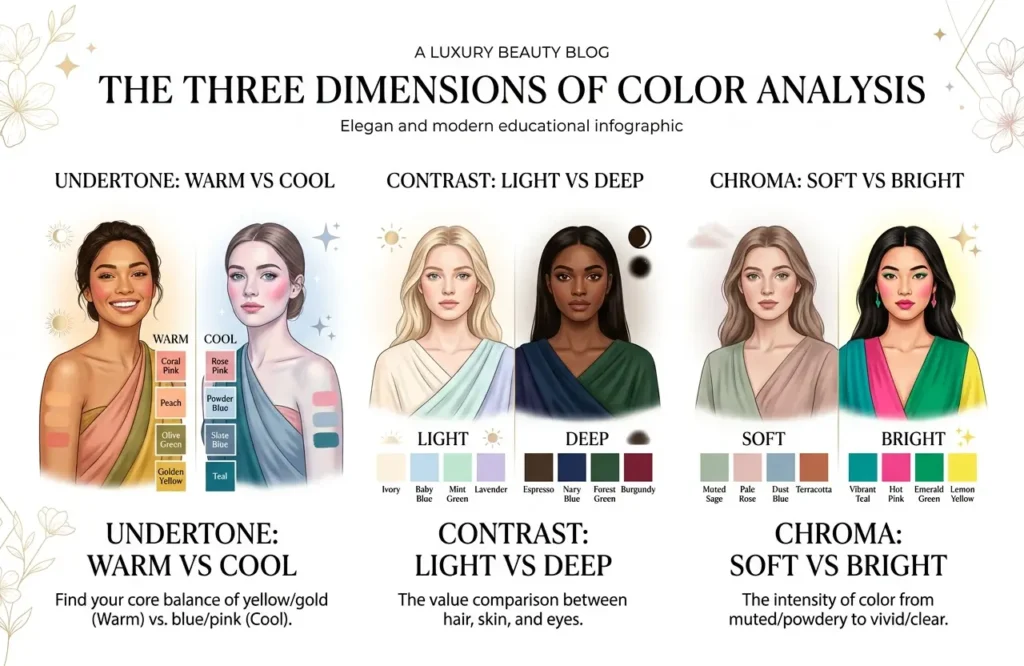
Your color season is based on three main things.
Hue / Undertone
This tells if your skin is:
- Warm (yellow, golden, peachy)
- Cool (pink, red, bluish)
Quick tip:
Gold jewelry often flatters warm undertones more, while silver jewelry often flatters cool undertones more.
But this is only a clue, not a final answer.
Value
This means how light or dark your features are.
Contrast means the difference between your skin, hair, and eyes.
- Light → fair skin, light hair, soft contrast
- Deep → dark hair, strong contrast
Chroma
This shows how soft or bright your coloring is.
- Soft → muted, blended features
- Bright → clear, high contrast features
Understanding the Four Seasonal Palettes
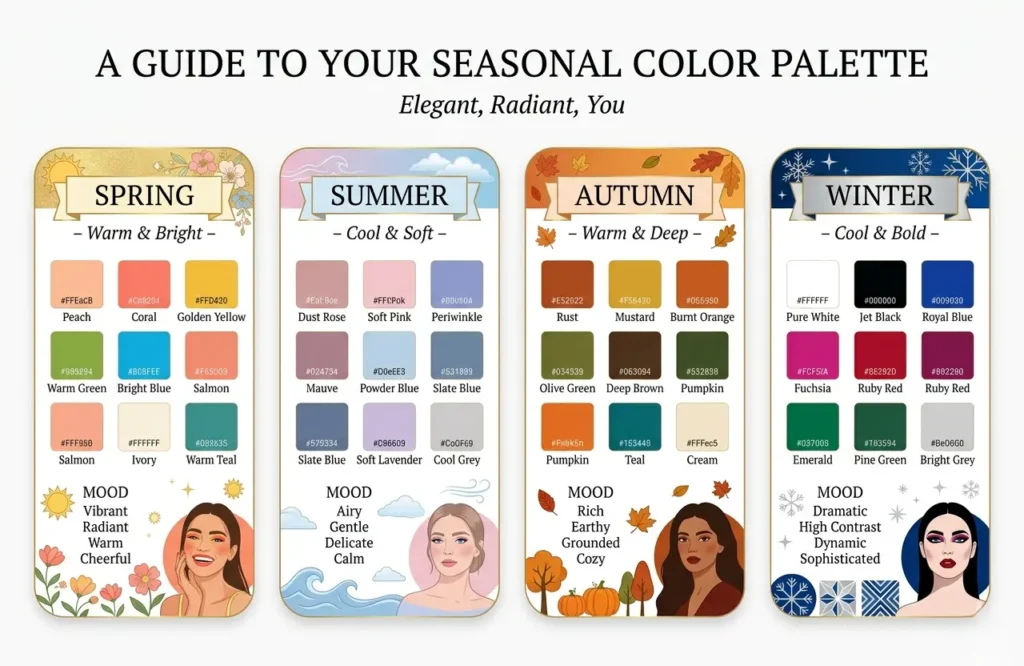
There are four main color seasons.
Each one has a different feel.
- Spring → warm and bright
- Summer → cool and soft
- Autumn → warm and deep
- Winter → cool and bold
Each season matches a certain type of natural coloring.
The 4 Main Color Seasons (Quick Overview)
Here is a simple way to see them:
- Spring: light, warm, fresh
- Summer: cool, soft, gentle
- Autumn: warm, rich, earthy
- Winter: cool, sharp, high contrast
This is the basic system.
But there is more detail if you need it.
| Season | Undertone | Best Look |
|---|---|---|
| Spring | Warm | Light, fresh, bright |
| Summer | Cool | Soft, gentle, muted |
| Autumn | Warm | Rich, earthy, deep |
| Winter | Cool | Bold, sharp, high contrast |
The Complete 12-Season Color Analysis System (2026 Edition)
The 4 seasons are often divided into 12 types.
This helps people who feel stuck between seasons.
Each season has 3 sub-types.
For example:
This gives more accuracy.
The 12-season system is useful because many people do not fit neatly into just one of the four main seasons.
You may feel close to a season, but still not fully match it.
That is where the sub-seasons help.
They give you a more exact match based on your:
- undertone
- depth
- softness or brightness
This makes it easier to choose colors that truly flatter you.
Explore the 12 seasons interactively
You can compare seasons side by side.
This helps you see small differences.
It is useful if you feel confused between two seasons.
Palette Preview!
Each season has its own palette.
These colors guide your:
- clothes
- makeup
- hair
This is where color analysis starts becoming useful in real life.
How to Discover Your Own Color Season
This is what most people want to know.
Let’s keep it simple.
Follow these steps:
- Check your undertone (warm or cool)
- Look at your contrast (light or deep)
- See if your features are soft or bright
These three steps will guide you.
A Simple Way to Narrow Down Your Season
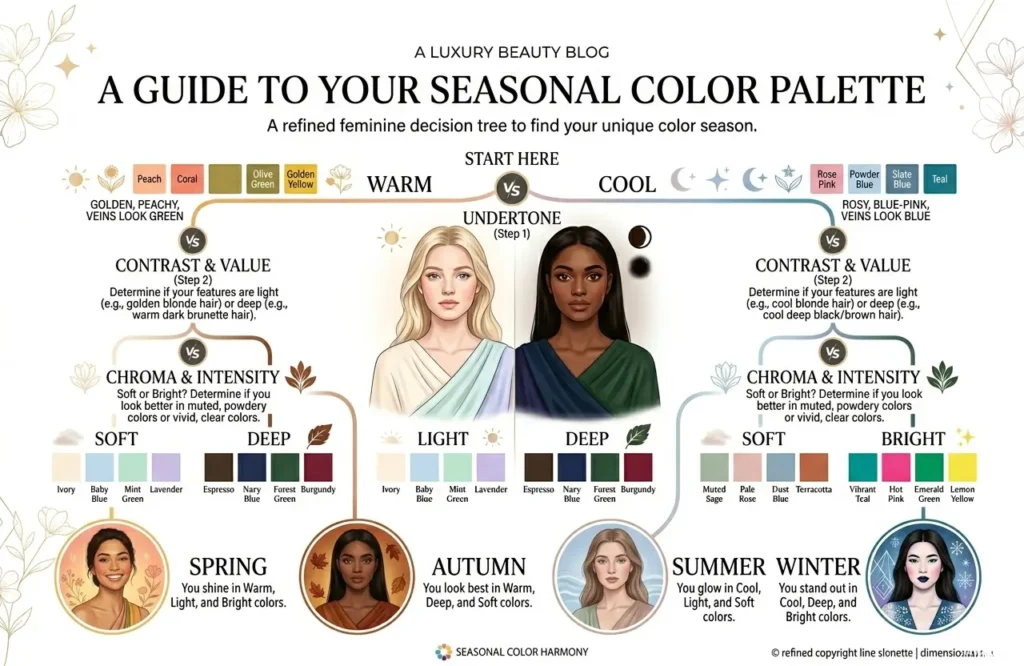
If you still feel unsure, this simple path can help.
Start with these three questions:
1. Are you warm or cool?
Look at which colors make your skin look healthier.
- Warm people often suit:
- peach
- coral
- warm beige
- olive
- Cool people often suit:
- icy pink
- cool blue
- berry
- pure gray
If warm shades make you look more alive, you may lean Spring or Autumn.
If cool shades make your skin look clearer, you may lean Summer or Winter.
2. Are your features light or deep?
Now look at the depth of your natural coloring.
- Lighter hair, eyes, and lower contrast often point to:
- Spring
- Summer
- Darker hair, deeper eyes, and stronger contrast often point to:
- Autumn
- Winter
3. Are your features soft or bright?
This helps you narrow it down even more.
- If your features look blended and gentle, you may be soft
- If your features look clear, sharp, or high contrast, you may be bright
This can help you move closer to your true season.
For example:
- Warm + Light + Bright → often points to Spring
- Cool + Soft + Light → often points to Summer
- Warm + Deep + Soft → often points to Autumn
- Cool + Deep + Bright → often points to Winter
This is not a perfect shortcut, but it gives you a much clearer starting point.
| If You Are… | You May Be… |
|---|---|
| Warm + Light + Bright | Spring |
| Cool + Soft + Light | Summer |
| Warm + Deep + Soft | Autumn |
| Cool + Deep + Bright | Winter |
How Do I Find My Color Season? (Traditional DIY Methods)
You can try these at home.
Fabric Draping (Most Accurate Traditional Method)
Hold different colors near your face.
Look in natural light.
Ask yourself:
- Does my skin look clear?
- Do my eyes stand out?
- Do I look more fresh or more tired?
If yes, that color suits you better.
This is one of the most helpful ways to test colors on yourself.
The Jewelry Test
Try gold and silver jewelry.
- Gold may suit you better if you lean warm
- Silver may suit you better if you lean cool
This is a quick test.
But again, it should only be used as one clue.
The Vein Test (Popular but Limited)
Look at your wrist veins.
Greenish veins can suggest a warmer lean, while bluish or purple-looking veins can suggest a cooler lean.
But lighting, skin depth, and vein visibility can make this test less reliable.
Use it as a small clue, not the final answer.
Why You Might Still Feel Stuck Between Two Seasons
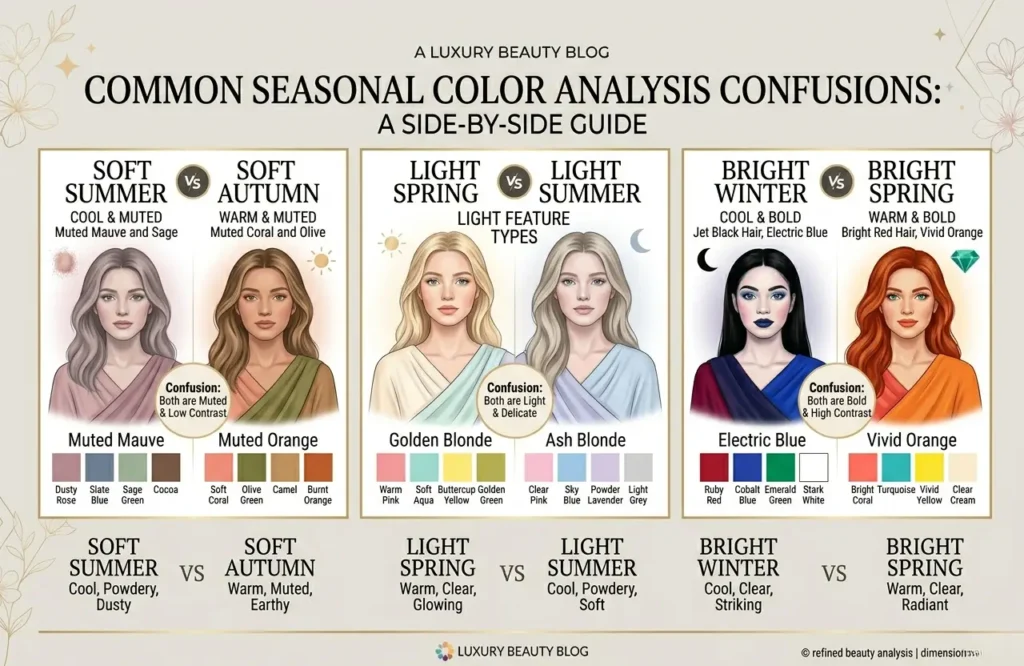
This is very common.
A lot of people do not fit neatly into one season at first.
You may feel stuck between two seasons if:
- your undertone looks neutral
- your hair and skin create mixed signals
- some warm colors work, but others do not
- some cool colors look good, but not all of them
This usually happens with seasons that sit close to each other.
Common examples include:
- Soft Summer vs Soft Autumn
- Light Spring vs Light Summer
- Bright Winter vs Bright Spring
If this sounds like you, do not panic.
It usually means your best colors sit in a narrower range, and that is exactly why the 12-season system can be more helpful than the basic 4-season model.
The goal is not to force yourself into a label.
The goal is to find the colors that make you look your best.
Common Mistakes People Make When Finding Their Color Season
It is easy to get the wrong result if you focus on the wrong clues.
Here are some of the most common mistakes:
Relying too much on hair color
Hair color matters, but it should never be the only clue.
For example:
- dark hair does not always mean Winter
- blonde hair does not always mean Spring or Summer
Using bad lighting
Yellow indoor lights can change how colors look on your skin.
Try color testing in natural daylight whenever possible.
Trusting only one test
The jewelry test or vein test can help, but they should not decide your whole result.
It is better to look at:
- undertone
- contrast
- softness or brightness
Choosing your favorite colors instead of your best colors
A color can be pretty and still not flatter you.
Your best colors are the ones that make your face look fresher and more balanced.
Assuming skin depth decides your season
Fair skin does not always mean Summer.
Deep skin does not always mean Autumn or Winter.
People of all skin tones can belong to different seasons.
If you have ever felt confused, you are not alone.
Most people need to compare a few clues before their season starts to make sense.
Exploring the Colors for Each Season
Once you find your season, you can use it in real life.
Each season has:
- best colors
- colors to avoid
Wearing the right colors can:
- make your skin glow
- reduce the need for heavy makeup
- make outfits look better
What to Do After You Find Your Color Season
Finding your season is just the start.
The real value comes from using it in everyday life.
Here are a few simple ways to use your color season:
1. Start with the tops near your face
If you want to test your best colors first, begin with:
- shirts
- scarves
- hijabs
- earrings
- makeup shades
These have the biggest effect on how your face looks.
2. Use your best neutrals first
You do not need a full, colorful wardrobe.
Start with easy basics like:
- black
- navy
- brown
- beige
- cream
- gray
The best neutral for you depends on your season.
3. Use off-season colors carefully
You do not need to throw everything away.
If you love a color outside your season, you can still wear it:
- farther from your face
- as shoes or bags
- mixed with more flattering shades
4. Shop with more confidence
Once you know your season, shopping gets easier.
You can stop buying random shades that look nice on the hanger but not on you.
That saves both money and time.
The Real-World Benefits of Knowing Your Colors
This is where things get exciting.
Knowing your color season helps you:
- choose better clothes
- save money while shopping
- pick better makeup shades
- choose the right hair color
You stop guessing.
You start choosing with confidence.
Why Knowing Your Color Season Changes Everything
When you wear your best colors:
- your face looks brighter
- your features look balanced
- your style looks more put together
You do not need to follow every trend.
You just need to follow what works for you.
Why So Many People Feel “Off” in the Wrong Colors
If you have ever felt like certain colors make you look tired, flat, or older, you are not imagining it.
Sometimes the problem is not:
- your makeup
- your skin
- your outfit style
Sometimes the color itself is working against you.
That is why seasonal color analysis feels so helpful to many people.
It gives a reason for things you may have noticed for years, such as:
- “Why do I look better in one white but not another?”
- “Why does one pink make me glow and another wash me out?”
- “Why do some outfits feel right even when they are simple?”
When you wear colors that match your natural coloring, you often need less effort to look polished.
That is what makes your best colors so useful.
Common Questions About Color Analysis
Can My Color Season Change Over Time?
Your underlying undertone usually stays the same.
But your overall coloring can look a little different over time because of:
- tanning
- gray hair
- hair dye
- skin changes
- age
That can slightly affect which shades look best on you, even if your core season stays similar.
What if I Have Neutral Undertones?
This is very common.
You may be:
- neutral-warm
- neutral-cool
In this case, you can borrow from nearby seasons.
This is one reason why some people feel stuck between two color seasons.
Does My Ethnicity Determine My Color Season?
No.
Anyone can belong to any season.
Your color season depends on your features, not your background.
Ready to Find Your Season?
By now, you should have a better idea of how color seasons work.
You do not need to guess as blindly anymore.
Start by testing colors in natural light and paying attention to what makes your face look brighter, fresher, and more balanced.
That is often where the answer begins.
The Best Way in 2026: Instant AI Color Analysis from a Photo
AI color analysis tools can be a faster way to get a starting point.
They usually look at things like:
- skin tone
- contrast
- facial coloring
But the result can depend on:
- photo quality
- lighting
- makeup
- filters
So AI can be helpful, but it works best when used with clear, natural photos.
Not Sure Which Color Season You Are?
Take our free 2-minute Color Season Quiz to discover whether you are most likely a Spring, Summer, Autumn, or Winter—and explore the colors that suit you best.
Final Thoughts
Finding your color season is not about following trends or trying to fit into someone else’s style. It is about understanding your own natural features and using color in a way that supports them. In my experience, many people are not struggling because they have poor fashion sense, but because they have never been shown how much color affects the way they look. Once they begin wearing shades that match their undertone, contrast, and overall coloring, getting dressed becomes easier and more natural. You do not need to figure everything out in one day. Start by testing colors in natural light, paying attention to what makes your face look brighter and more balanced. Over time, your season becomes easier to recognize, and once it does, choosing the right colors becomes far less confusing.
